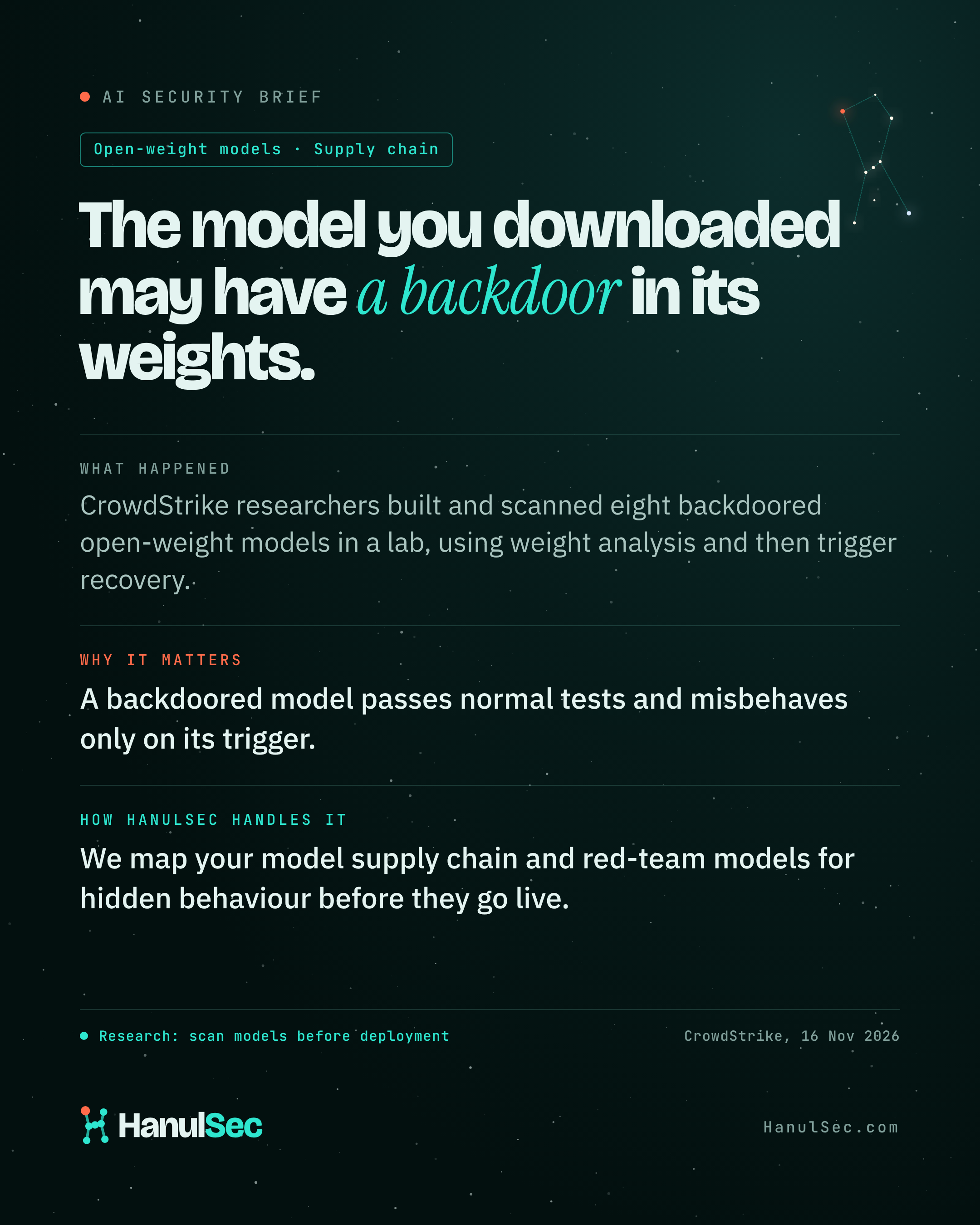
The model you downloaded may have a backdoor in its weights.
CrowdStrike researchers built and scanned backdoored open-weight models in a lab to show a growing supply-chain gap: a model can behave normally until a hidden trigger appears, and ordinary testing will not notice.
- CrowdStrike calls open-weight models a supply-chain trust gap: each download trusts that nobody tampered with it.
- The researchers built and scanned eight backdoored models in a controlled lab environment.
- Their approach has two stages: static analysis of the weights, then recovering the hidden trigger.
- Researchers: Donato Onofri, Paul Urian and Jonathan Bar Or. This is research, not a single product flaw.
What happened
On 16 November 2026, CrowdStrike published “Hidden in the Weights: Supply Chain Risk from Backdoored LoRA Models”. The researchers argue that every time an organisation downloads an open-weight model, it trusts that the model was not tampered with before release. They built and scanned eight backdoored models in a controlled lab, using a two-stage method: static analysis of the weights first, then trigger recovery for models that look suspicious.
Who is affected
- Teams that download open-weight models, LoRA adapters or merged models
- Companies fine-tuning or hosting their own models
- Anyone deploying models from public hubs without checking them
Why it matters
A backdoored model behaves normally in everyday tests and only misbehaves when it sees a specific trigger. If that model drives a chatbot, an agent or a decision, the attacker controls when it goes wrong. Normal accuracy checks will not catch it, so models need the same supply-chain scrutiny as software packages.
What to do now
- Keep an inventory of every model and adapter you use, and where it came from.
- Prefer publishers you can verify, and pin exact versions and checksums.
- Scan models when they enter your environment, and review flagged ones before deployment.
- Limit what a model’s output can trigger on its own, so a hidden backdoor has less reach.
How HanulSec helps
- We map the models, adapters and datasets in your AI supply chain.
- We test models for hidden behaviour with targeted red-teaming before they go live.
- We review what each model can trigger, so one bad model cannot cause serious harm.
Tell us what you run and we will send a fixed-price proposal within one business day. Request a quote.