An AI agent turned a security patch into an exploit on its own.
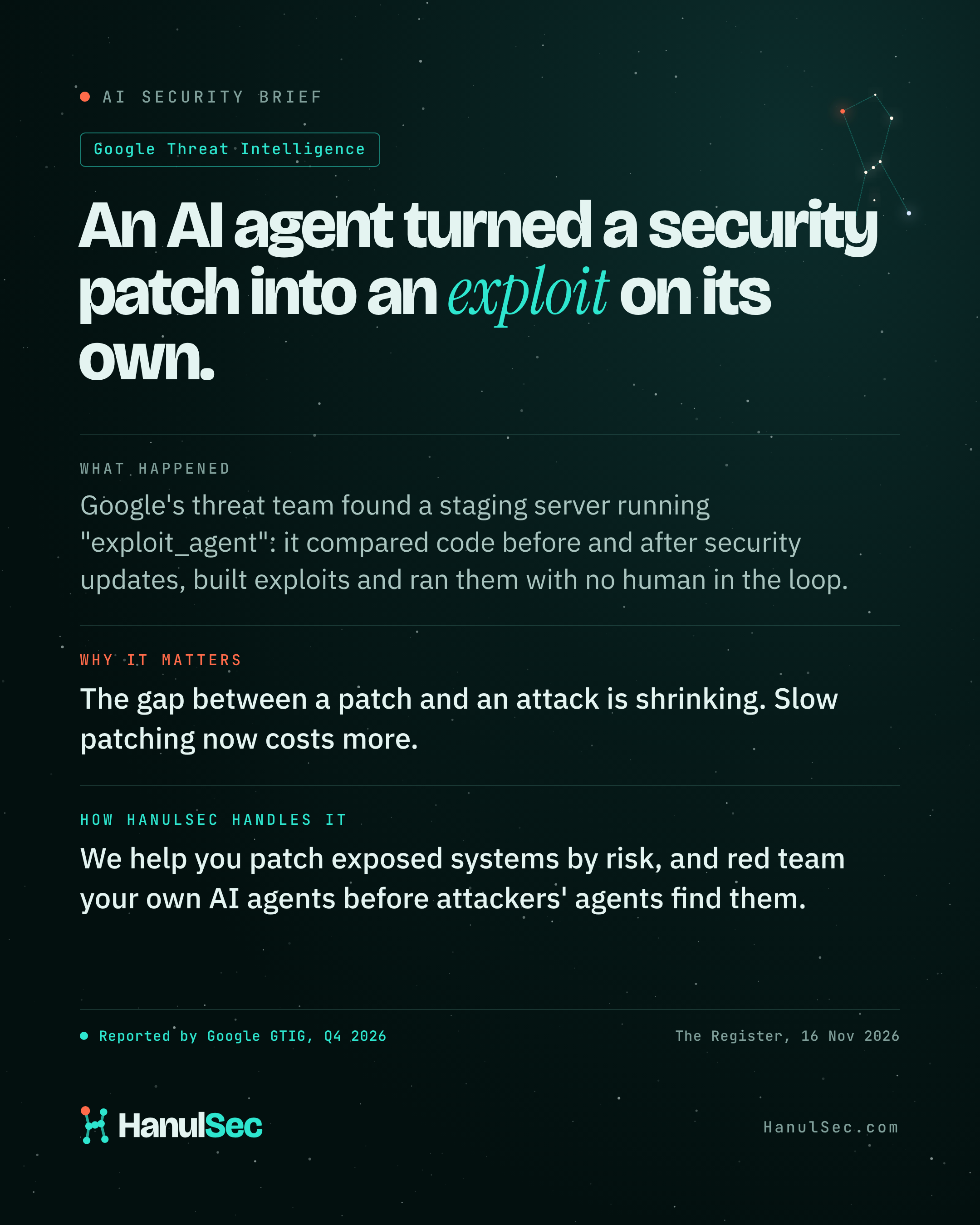
Google’s Threat Intelligence Group found an attacker’s framework that compared software before and after security updates, wrote working exploits and ran them with no human in the loop. Google calls it a first.

- Google found an exposed staging server hosting a framework called exploit_agent.
- It compared code before and after security updates, developed exploits and ran them automatically.
- The operator was suspected to be Russian-speaking; victim data suggested interest in French media, entertainment and education sites.
- The time between a patch and an attack is shrinking, so patching speed matters more than ever.
What happened
According to The Register’s report of 16 November 2026 on Google’s Q4 2026 AI threat tracker, the Google Threat Intelligence Group (GTIG) found an exposed staging server used by a suspected Russian-speaking operator. It hosted a framework called exploit_agent that compared code before and after security updates, worked out what had been fixed, built working exploits and ran them against victims, with no human in the loop. GTIG described it as a first such occurrence.
Who is affected
- Any organisation with internet-facing software that receives security patches
- Teams that patch on a monthly cycle or slower
- Companies building their own AI agents with access to tools and systems
Why it matters
Turning a patch into an exploit used to take skilled people days or weeks. If an AI agent can do it automatically, the window between “patch released” and “attack in progress” gets much shorter, and every day a known flaw stays open is worth more to attackers.
What to do now
- Patch internet-facing systems first, and track how long critical patches take.
- Keep an up-to-date list of what you expose to the internet.
- Watch CISA’s Known Exploited Vulnerabilities catalogue and your vendors’ advisories.
- Treat your own AI agents as privileged software: limit their permissions and log what they do.
How HanulSec helps
- We rank your internet-facing systems by how quickly a public patch could become an attack.
- We test exposed services the way an automated attacker would.
- We red team your own AI agents, so they do not become the next foothold.
Tell us what you run and we will send a fixed-price proposal within one business day. Request a quote.