An AI gateway flaw is now on CISA’s exploited list.
On 18 November 2026, CISA added a LiteLLM sandbox escape to its Known Exploited Vulnerabilities catalogue. If your company routes AI traffic through LiteLLM, this is a patch-now issue.
- CVE-2026-40217 lets code sent to LiteLLM’s guardrail test endpoint escape its sandbox and run inside the proxy process.
- In the default Docker image that process runs as root. Reaching the endpoint needs a proxy-admin credential in default setups.
- CISA added it to the Known Exploited Vulnerabilities catalogue on 18 November 2026, with a federal deadline of 2 December.
- The Cloud Security Alliance says LiteLLM 1.83.14-stable is the first release that fixes the full attack chain.
What happened
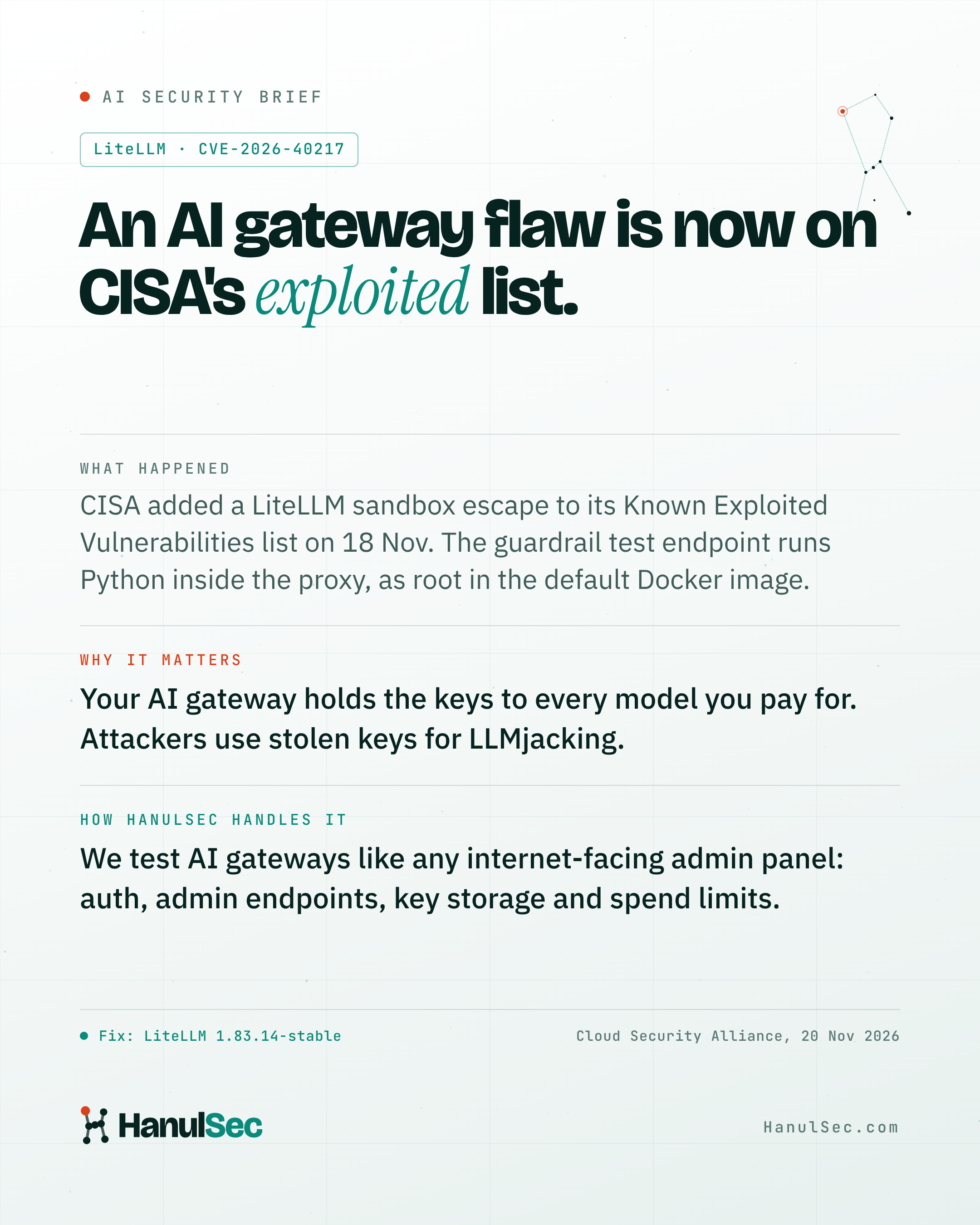
LiteLLM is a popular open-source gateway that sits between applications and AI model providers. It holds the API keys, routes requests and applies guardrails. Researchers at X41 D-Sec found that the guardrail test endpoint (POST /guardrails/test_custom_code) runs administrator-supplied Python inside the proxy process, and that the sandbox around it can be escaped. In LiteLLM’s default Docker image, that process runs as root.
On 18 November 2026, the US Cybersecurity and Infrastructure Security Agency (CISA) added the flaw, CVE-2026-40217, to its Known Exploited Vulnerabilities catalogue. The Cloud Security Alliance notes that Obsidian Security chained it with two further LiteLLM flaws, and that Google’s threat intelligence team has linked LiteLLM abuse to “LLMjacking”, where attackers steal AI keys and run up large bills.
Who is affected
- Teams that self-host LiteLLM as an AI gateway or proxy, especially in the default Docker image
- Anyone whose LiteLLM admin interface or admin keys are reachable from the internet or a wide internal network
- Companies that store several AI provider keys in one gateway
Why it matters
An AI gateway is a single place that holds the keys to every model a company pays for, and often sees every prompt and answer. Whoever controls it can read sensitive conversations, run up the bill and use the server as a foothold into the rest of the cloud. Being on CISA’s exploited list means attackers are already using flaws like this one.
What to do now
- Update LiteLLM. The Cloud Security Alliance names 1.83.14-stable as the first release that fixes the full chain.
- Block
POST /guardrails/test_custom_codeat your reverse proxy if you do not use it. - Make sure the admin interface is not reachable from the internet, and rotate admin keys.
- Rotate the model-provider API keys stored in the gateway, and set spend limits and alerts with each provider.
- Check that the container does not run as root.
How HanulSec helps
- We find every AI gateway and proxy your teams run, including the ones only developers know about.
- We test admin endpoints, authentication and container privileges like any internet-facing admin panel.
- We check key storage, spend limits and alerts, so abuse is caught in hours, not at the end of the month.
Tell us what you run and we will send a fixed-price proposal within one business day. Request a quote.