One malicious webpage took an AI agent all the way to its credentials.
Researchers at NebuSec chained a malicious webpage, a browser flaw and a kernel flaw to move from Meta Muse’s web browsing to stored memories, private chats and credential storage, in a lab demonstration that has since been patched.
- NebuSec says an attacker-controlled webpage could make Muse’s agent export it, giving code execution through a flaw in its built-in Chromium browser.
- Outbound requests carrying conversation history and stored memories went out without a prompt to the user.
- A Linux kernel flaw then allowed escape to root in the user’s virtual machine, reaching credential storage.
- NebuSec says all the exploits were patched by publication, and the work stayed on one user’s machine.
What happened
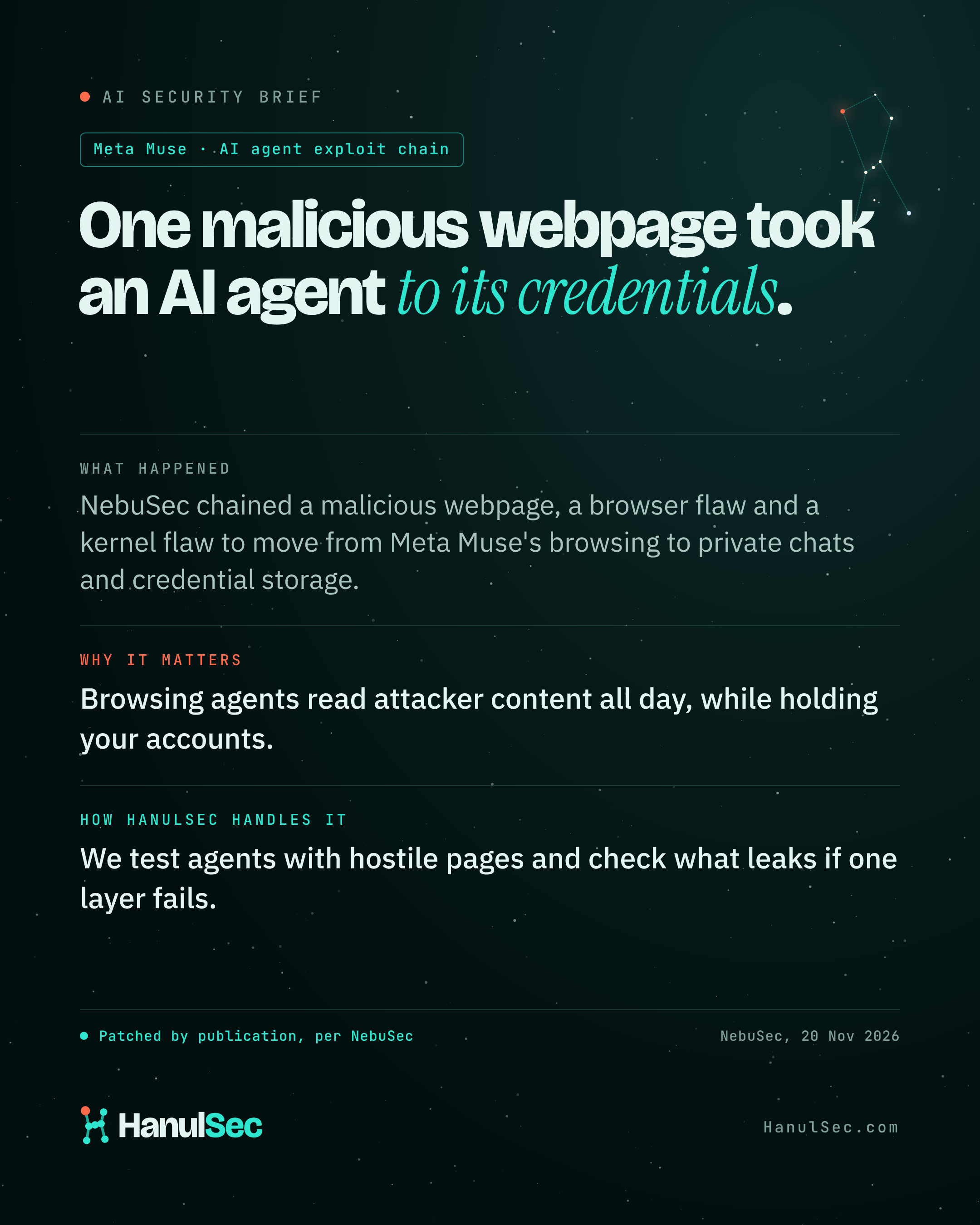
On 20 November 2026, NebuSec published research on Meta Muse, a personal AI agent that works through users’ connected accounts. It describes a chain that started with a malicious webpage the agent was asked to export, gained code execution through a flaw in the agent’s built-in Chromium browser, sent conversation history and stored memories out without prompting the user, and used a Linux kernel flaw to reach root in the user’s virtual machine and its credential storage. NebuSec says all the exploits had been patched by the time of publication and that the work did not reach the host or other users.
Who is affected
- Users of AI agents that browse the web on their behalf
- Companies building agents with built-in browsers, file export or memory
- Teams relying on a single sandbox to contain an AI agent
Why it matters
Agents that browse the web read attacker-controlled content all day. When the agent also holds memories, chats and account credentials, one bad page can become a full compromise. Each layer, from the browser to the container to the virtual machine, has to hold on its own.
What to do now
- Treat every page an agent opens as hostile input.
- Require user approval for outbound requests that carry personal data or memories.
- Keep agent browsers and the underlying kernel fully patched.
- Store credentials outside the environment where the agent runs code.
How HanulSec helps
- We test agents with malicious pages and documents, from prompt injection to browser exploits.
- We check which data and credentials an agent could leak if one layer fails.
- We review sandboxing, approvals and egress controls around your agents.
Tell us what you run and we will send a fixed-price proposal within one business day. Request a quote.