Your prompts went to an AI provider. Someone else read them too.
Dragos researchers planted canary URLs and AWS keys in about two million AI prompts. Attackers used them, revealing months of data theft at three inference providers. OpenRouter has off-boarded those providers and notified affected customers.
- Dragos, with researcher HD Moore, seeded about two million AI prompts with canary URLs and AWS keys between July and November 2026.
- Seeded prompts were later used in attempts to access Dragos’s test systems and canary AWS accounts, exposing theft at three inference providers.
- The earliest breach began in mid-July. Some stolen requests were flagged for zero data retention.
- OpenRouter off-boarded three providers, removed 125 endpoints from zero data retention eligibility and notified affected customers.
What happened
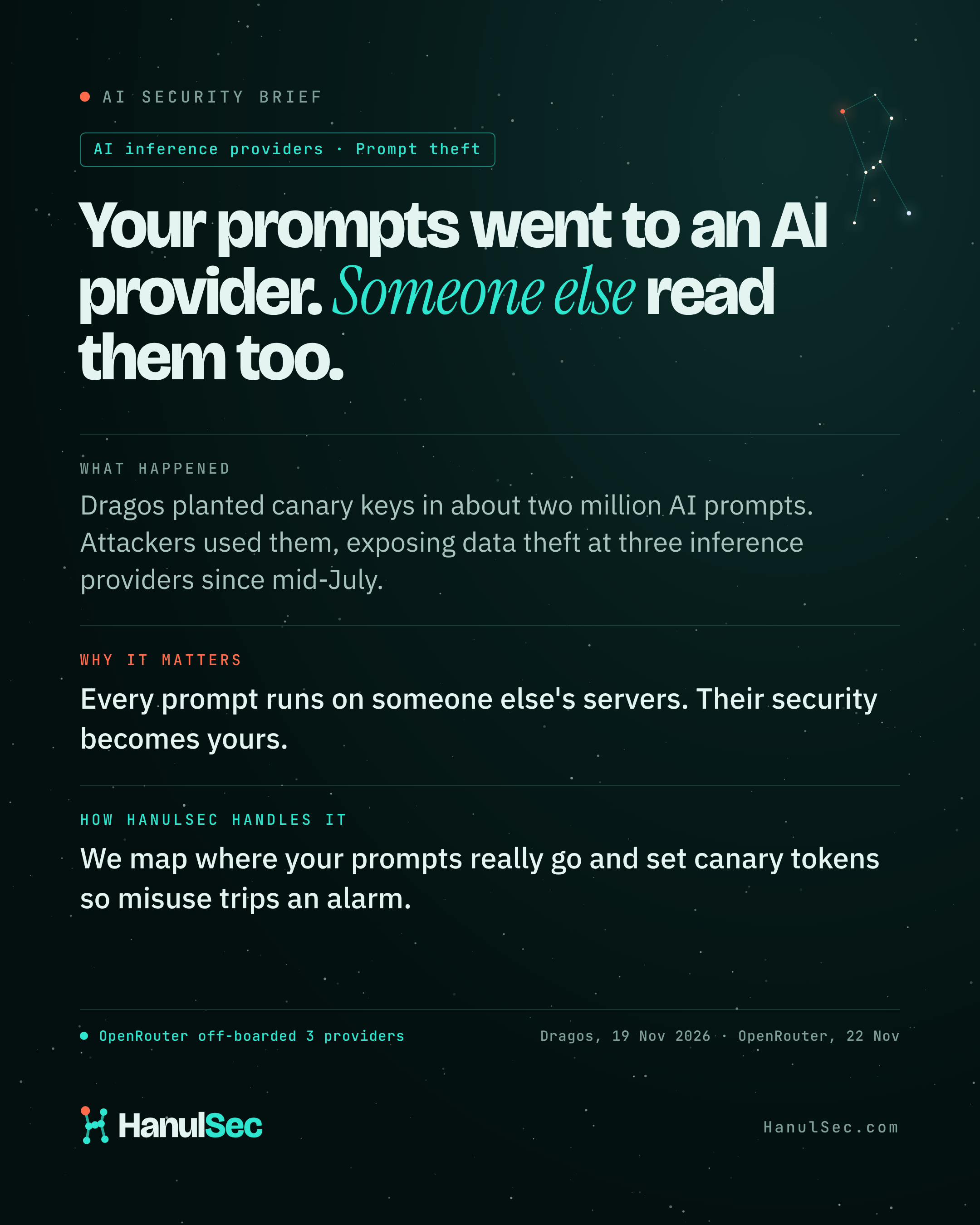
On 19 November 2026, Dragos published research in which it seeded about two million AI prompts with canary URLs and AWS keys, then watched for their use. Dragos says its seeded test prompts were used in attempts to access its controlled test systems and canary AWS accounts, revealing data theft at three inference providers, the earliest starting in mid-July. On 22 November, OpenRouter said it had off-boarded three providers, removed 125 endpoints from zero data retention (ZDR) eligibility and notified potentially affected customers, and that the findings did not show a breach of OpenRouter itself.
Who is affected
- Companies sending prompts through AI routers or marketplaces to third-party inference providers
- Teams relying on zero data retention promises for sensitive prompts
- Anyone who has put secrets, keys or customer data into prompts
Why it matters
Every prompt travels through someone else’s infrastructure. If it contains customer data, source code or keys, the provider’s security becomes yours. This research shows that “zero data retention” is a promise, not a guarantee, and that the only way to know is to test it.
What to do now
- List every AI provider and router your prompts pass through, including ones chosen automatically.
- Keep secrets and keys out of prompts, and rotate any that have been sent.
- Prefer first-party or self-hosted models for sensitive data.
- Plant canary tokens in test prompts so misuse trips an alarm.
How HanulSec helps
- We map where your prompts and AI data actually go, provider by provider.
- We check prompts, logs and agent traffic for secrets that should not be there.
- We set up canary tokens and alerts so data misuse is caught early.
Tell us what you run and we will send a fixed-price proposal within one business day. Request a quote.